I don't know what it is about mushrooms that intrigues me. Possibly childhood story books showing fairies living in and playing around them, Or the story that my beloved maternal grandmother told me about my mom (under the age of five) skipping home from the next door neighbor's yard with a rather LARGE white circle shaped item in her hand calling out "Looky, looky at my cookie". The "cookie" turned out to be the cap of a large mushroom that my mom had taken several bites out of. This of course led to a trip to the ER with my mom getting her stomach pumped. Maybe it was the artist in me that loved to draw and then color in mushrooms with fantastical designs. Who knows - but I love these little fungi and am delighted when I find them growing in my garden! So I'd like to share some pictures that I've taken and a little bit about each one.

This is the Honey Fungus. It's Latin name is Armillaria Mellea. It's cap is honey-colored with a ring on the stem and notched gills. It spreads via underground root-like structures called rhizomorphs, forming some of the world's largest living organisms! While some species are edible, this fungus is a destructive plant pathogen, attacking a wide range of trees and shrubs, the rhizomorphs cause root rot at the base of the plant as it digests the wood and roots. I snapped it's picture in Irvine Regional Park.

Meet Coprimus Comatus also known as the Shaggy Ink Cap. Cap: starts as a white cylinder, then opens to a bell shape with shaggy, curling scales.
Gills: White when young, turns pink and then black as it dissolves. Thus its common name!
It loves to grow in disturbed areas like lawns and roadsides, and is a choice edible when young. It will grow singularly or in small groups.
I found this group along the Oso Creek Trail in Mission Viejo.

I found this Chicken of the Woods (Laetiporus Sulphureus) in Bart Spendlove park in Mission Viejo. This bracket fungus is known for its chicken-like texture and taste when cooked. It can be used as a chicken substitute in recipes. The ones that grow on oak trees are edible, but AVOID specimens found growing on eucalyptus or yew trees due to potential toxicity. It should always be cooked thoroughly to avoid stomach upset. This beauty is rich in protein, potassium, and vitamins A and C!

I took this picture of a Ganoderma in O'Neill Park, standing above it, so that you can see why it is commonly known as a shelf (also bracket) fungi. They are wood-decaying fungi, often found on living or dead hardwood and conifer trees, causing root and trunk rot. They are also used in traditional medicine for their bioactive compounds. Species like G. lucidum have been used for centuries in traditional Asian medicine for purported health benefits.
Their ecological role is that they break down cellulose and lignin, the structural components of wood. Many species are parasitic and pathogenic, causing root rot and basal stem rot, which can lead to tree failure, specially in palms and hardwoods like oak, maple, and ash. Unfortunately, once a tree is infected with Ganoderma, there is no effective chemical treatment to cure it, so the infected tree should be removed.

This Common Puffball (Lycoperdon perlatum) was found in the garden of Inveraray Castle (the ancestral seat of the Clan Campbell) on the shore of Loch Fyne in Scotland. This little cutie pie is edible when young and pure white inside. When mature, puffballs release a cloud of brown spores through a hole in the top of its cap, when squeezed or hit by rain, which can cause lung irritation if inhaled.
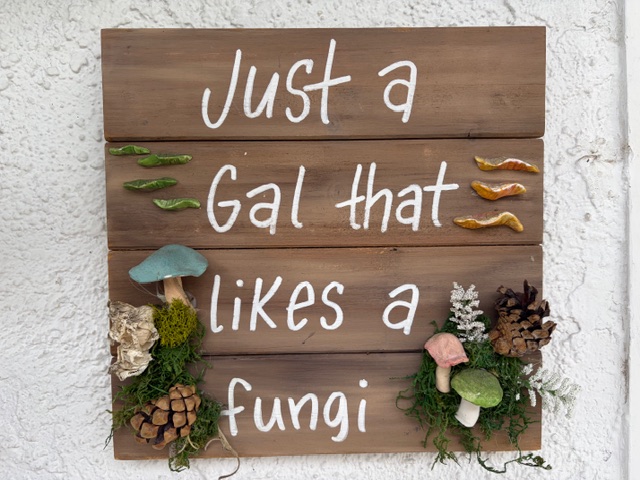
I'll end January's newsletter with this sign that hangs in my back yard...

Contributed by Cindie Reilly
MLHMGT Board member
