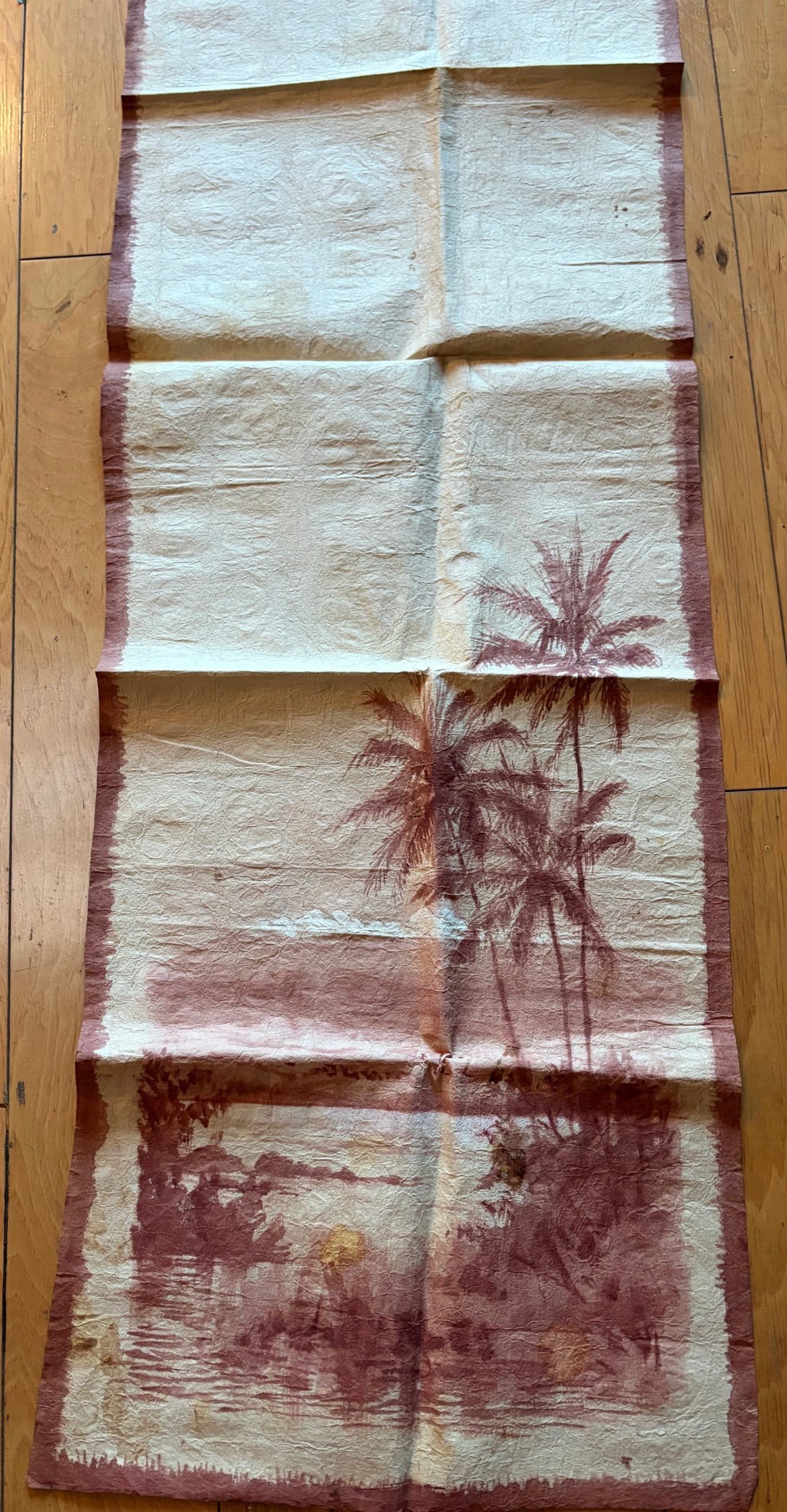
My paternal grandmother, Dorothy Edna Richards was born on November 28, 1896 in Hilo, Hawai'i. Her father Elmer Ellsworth Richards had been sent to Hilo by the Sunset Telephone-Telegraph Company (operating under the umbrella of the Pacific Bell Telephone Company) in San Jose, CA to help set-up the Hōlualoa Telephone Exchange.


When Dorothy moved to San Diego, CA in 1915, one of the items she brought with her were several pieces of Kapa Cloth (also known as Tapa Cloth) that was gifted to her father from Queen Liliʻuokalani, the last sovereign Queen of Hawai'i.
My grandmother said that the cloth on the left was used as a table runner and the piece on the right was used as a tablecloth. It has since been cut up into smaller pieces that was shared with other family members.


Kapa is a fabric made by native Hawaiians from the bast fibers of certain species of trees and shrubs in the orders Rosales and Malvales. The bark is beaten and felted to achieve a soft texture and dye stamped in geometric patterns. This long-established practice of making this type of "fabric" is thought to have been taken to Hawai'i by ancient Tahitian settlers during the 14th Century.
Similar to tapa found elsewhere in Polynesia (the Hawaiian phoneme /k/ corresponds to /t/ in most other Polynesian languages), kapa differs in the methods used in its creation. Kapa is based primarily on the creative combination of linear elements that cross and converge to form squares, triangles, chevrons, and diagonal forms, giving a feeling of boldness and directness. Kapa was used primarily for clothing like the malo worn by men as a loincloth and the pāʻū worn by women as a wraparound. Kapa was also used for kīhei, a shawl or cape worn over one shoulder. Other uses for kapa depended on caste and a person's place in ancient Hawaiian society.
Kapa moe (bed covers) were reserved for the ali'i or chiefly caste—several layers of kapa would be stitched together at the edges to form a kapa moe. Kapa robes were used by Kahuna or priestly caste. Kapa was also used as banners where leis were hung from it and images of their gods were printed on it.


Kapa Cloth was made from the bark of the Paper Mulberry (Broussonetia papyrefera) shown above left and Breadfruit (Artocarpus altilis) trees, shown above right.
Being my family's resident genealogist (and the oldest child) I am honored to be the keeper of this beautiful cloth. Thank you for allowing me to share it with you!
